For years, “performance” in user acquisition has often been used as shorthand for cheaper installs. But as budgets tighten and boards demand clearer accountability, the conversation is shifting toward outcomes that actually map to business value — registrations, deposits, trades, wagers, and other down-funnel events.
In the latest edition of App Talks, David Murphy spoke with Lee Aho, Chief Revenue Officer at Perform[cb], about how outcome-based acquisition models are evolving, why CPI and CPE aren’t mutually exclusive, and what it takes to make growth more predictable in an increasingly scrutinised spend environment.
Outcome-based UA, explained
Lee opened with a simple positioning: Perform[cb] drives net-new users on an outcome-based model, meaning brands pay for new users aligned to business-defined “quality” — not just top-of-funnel volume.
That definition of quality varies by vertical. In mobile, it might be account registration, a linked bank account, a first-time deposit, a first wager, or a first trade. The key is that optimisation is centred on leading indicators that reflect downstream value.
The advantage, Lee argued, comes from scale. Working across hundreds of brands allows Perform[cb] to ingest down-funnel signals at volume, learn what tends to predict quality, and apply that learning to new programs with more confidence than teams operating in a single account silo.
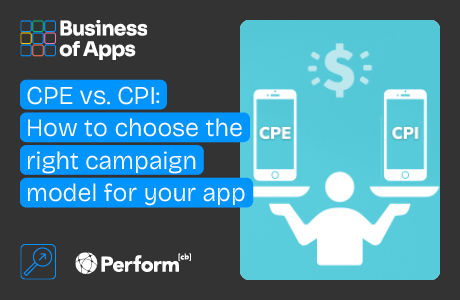
CPI vs CPE: A false trade-off
David raised a question many growth teams face: Should they optimise around CPI or CPE?
Lee’s answer was to reframe the debate. CPI and CPE are commercial models, not competing strategies. CPI doesn’t have to mean low-quality acquisition; rather, it depends on what signals you feed into the system.
Perform[cb] supports both, and Lee noted that their optimisation approach stays consistent regardless of the billing model: it still centres on down-funnel outcomes.
Where the models diverge is practical execution. CPE programs can introduce a lag — if the payable event happens days after install, media buyers lose fast feedback and scaling slows. CPI can remove that friction by making performance measurable sooner, attracting more buying partners, and speeding experimentation.
On the other hand, if a brand can monetise a specific down-funnel event effectively, it may be able to pay a competitive CPE that motivates partners and improves overall performance.

In short, each model has a place, and the right choice depends on the business and the buying reality.
Performance-based user acquisition for apps
Source: Business of Apps via YouTube
Turning data into predictability
Lee’s broader point about data wasn’t that marketers lack it, it’s that they often lack context.
Internal teams tend to evaluate performance in isolation, which makes it difficult to identify which signals are genuinely predictive and which are noise. Perform[cb] positions its cross-program view as the missing layer: one program shows what happened; hundreds of programs help indicate what’s likely to happen next.
That broader pattern recognition, Lee said, can create a “high-confidence starting point” at launch. Instead of beginning from zero, teams can use prior learnings around audiences, placements, and partnerships that typically work for similar programs. As more client-specific signals come in, performance improves through a feedback loop.
Keyword conquesting as a measurable growth lever
The conversation then shifted to keyword conquesting, which Lee described as increasingly attractive because it can offer something rare: a predictable blueprint.
With enough market and competitor data, a conquesting proposal can be modelled in advance, mapping the keyword landscape, a brand’s current rank, the likely investment required to reach top placement, and the organic lift expected from that ranking gain.
Lee emphasised the compounding effect: improving keyword rank can lift category rank, which can accelerate organic growth over time. In that sense, keyword conquesting becomes one of the clearest examples of paid spend producing a measurable organic payoff, assuming it’s funded and maintained rather than treated as a short-term burst.
Why rewarded environments are growing
Rewarded placements are also drawing more brand spend, largely because they change the user experience from interruption to choice.
Lee noted that Perform[cb] historically avoided rewarded environments, viewing them as potentially misaligned with quality objectives. That shifted after a significant investment a couple of years ago and after seeing strong returns and evidence of high-intent users who “stick around”.
The critical condition, he argued, is depth. Rewarded works best when payable events happen further down funnel. If users choose to engage and then have enough exposure to build real affinity with the product, rewarded can drive stronger intent and better downstream performance. Giving consumers options, letting them select which programs to engage with, can further sharpen that intent signal.
A structured approach to pilots
Pilot programmes can be a fast route to partnerships or a waste of time. Lee said many fail because they’re too small, too short, or disconnected from the metrics that actually matter.
Perform[cb] has leaned into a “funded pilot” framework, offering brands up to $10,000 in free traffic to generate a dataset that supports smarter decisions about future spend allocation. Lee said the company has seen multiple pilots translate into multi-million dollar partnerships.
The structure matters. In Lee’s view, successful pilots require:
- Clear KPIs upfront
- Alignment on what “success” unlocks post-pilot
- A defined scale plan for months one to three
- Close operational collaboration to ensure performance maps to business outcomes
Which verticals are leaning in
Perform[cb] is category-agnostic, Lee said, but highlighted strong traction in finance over the past several years, alongside lifestyle categories such as personal finance, credit, health, and wellness. He also pointed to momentum in entertainment and streaming, and e-commerce and shopping.
The common thread is marketer appetite for measurable outcomes and predictable scale and the willingness to optimise around business value rather than surface-level volume.
The takeaway
As Lee put it, brands want acquisition that ties spend to outcomes and scales with predictability. In a market where every dollar must be defended, performance-based models have moved from a niche approach to a mainstream expectation, especially for teams looking to grow faster, with clearer accountability.
Watch the full App Talks episode for Lee Aho’s complete perspective on outcomes-based acquisition, keyword conquesting, rewarded environments, and how to structure pilots that actually convert into long-term partnerships.
You can also watch all episodes of App Talks here.